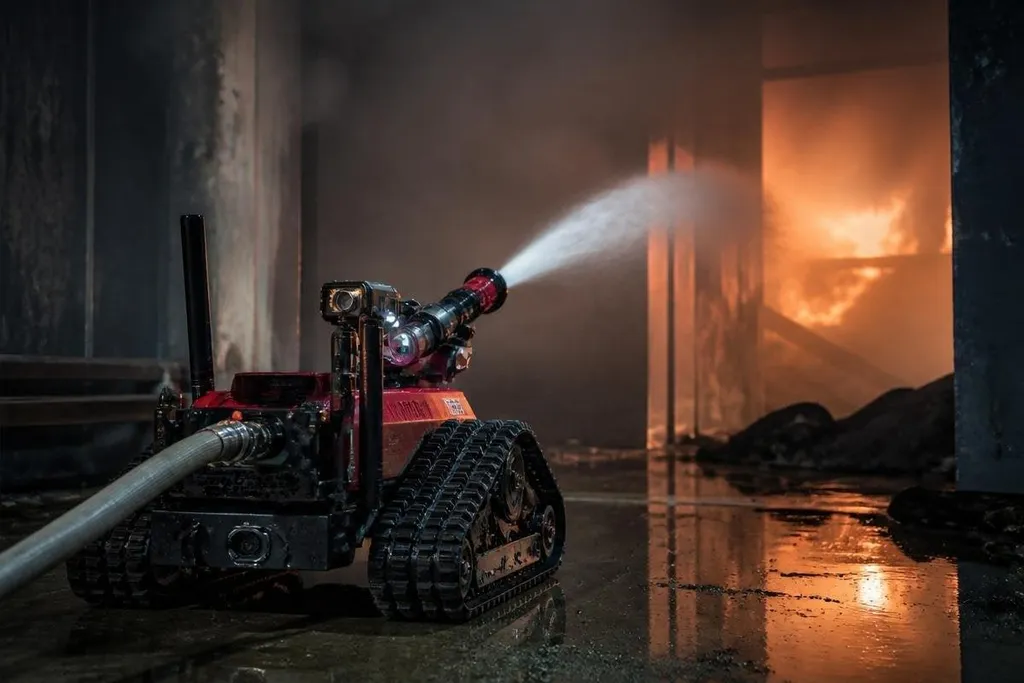
A firefighting robot has to work where heat, smoke, water, and broken floors stop people from moving safely. The next useful advances will come from machines that send better information, carry heavier tools, and keep working after contact with the scene.
- Thermal cameras can show heat through smoke, but their readings still need context.
- Tracked robots suit stairs, rubble, and wet floors better than small wheeled platforms.
- Remote control remains the practical choice when the building blocks reliable autonomy.
Thermal vision that helps crews act
A normal camera can lose the room when smoke blocks visible light. A thermal camera shows temperature differences, so a robot can help locate a hot door, a person-shaped heat source, or a fire behind part of a wall.
Turning sensor readings into a clear map for the crew outside is the useful step. The operator needs to know where the robot is, which route it took, and whether a hot area is getting larger. A color image alone cannot answer those questions.
Heat also changes the hardware. Cables, batteries, seals, and camera housings must keep working when the robot moves close to the fire. Makers should publish the temperature range for each part, the time limit near that heat, and the point where the robot must turn back.
Machines that carry tools, not only cameras
A robot with a camera can scout. A more useful one can also move a hose, open a door, clear a light obstacle, or carry a sensor to a safer position.
That work needs force at the arm, grip, and drive system. It also needs a chassis that stays planted when the arm pushes against a door or when a hose pulls from behind. A light platform may cross a flat floor well, then stop at a threshold or lose grip on wet concrete.
The tradeoff is weight. Larger batteries and stronger motors let a robot carry more equipment, but they also make transport harder.
Fire crews may need to load the robot into a truck, move it through a narrow entrance, and recover it after the mission. A machine that needs a second vehicle is harder to use when time and access are limited.
Autonomy should earn its place
Smoke, heat, falling objects, and changing floor plans make autonomous movement difficult. A robot can map a corridor with LiDAR, a sensor that measures distance with laser pulses, but the map may change after a wall collapses or a door opens.
Remote control gives the crew a direct say over movement and tool use. Autonomy can still help with steady driving, obstacle warnings, route recording, and return-to-operator behavior. That division keeps the risky decisions with a trained person and lets the robot handle repeatable movement.
The radio link becomes part of the robot's safety system when smoke, walls, and heat separate it from the crew. Robot24 can connect reports on firefighting machines with the tests and control systems behind them, leading into the next question: what happens when the link slows or drops?
The open question is the link between the robot and the operator. A video feed that freezes, hides depth, or delays movement can make a capable machine hard to control. Makers should report network range, delay, recovery after signal loss, and the controls used with gloves and breathing equipment.
What buyers should ask for
A fire department comparing machines can use this check before a purchase or trial:
- Heat limits: Ask for tested temperature limits for the full robot, not only the camera.
- Scene data: Check whether the crew can save maps, video, heat readings, and robot position.
- Tool work: Test the hose, arm, door, or sensor task the department actually needs.
- Ground access: Run the robot over wet floors, thresholds, stairs, and loose debris.
- Control loss: Cut the connection and check whether the robot stops safely or returns.
- Crew load: Measure how many people, cases, and minutes the machine needs before use.
A polished video proves that a robot completed one task under chosen conditions. It doesn't prove that the same system will work through smoke, water, poor radio coverage, and damaged buildings.
The next proof point
I'd skip any purchase based only on a rescue demo. Ask for repeatable trials on the floors, heat levels, tools, and radio systems your crews already use, then record the failures as carefully as the successful runs.
The firefighting robot worth watching is the one that reports its limits clearly and gives crews useful control when the building stops behaving like a test site.